


Airpower Advantage - Planning The Gulf War Air Campaign 1989-1991
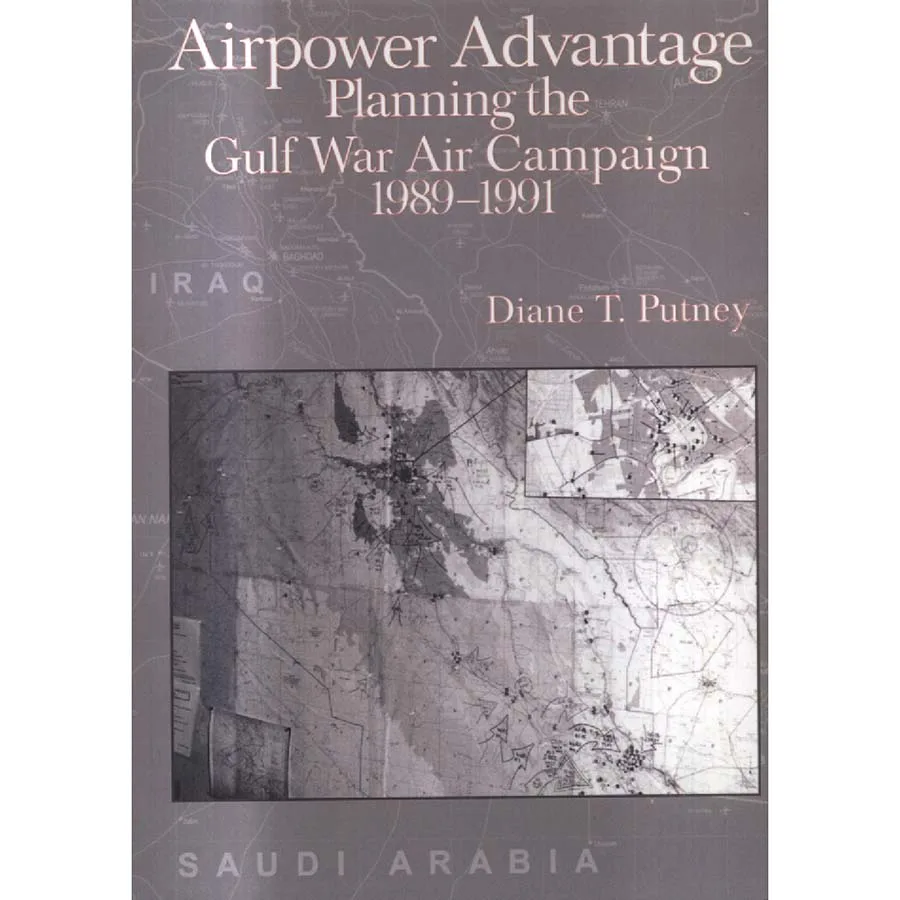
Publisher: Air Force History and Museums Program
Format: Paperback
ISBN: 9781477551202
Here’s one for Crappy Old Books:
Some military histories tell you what happened. Airpower Advantage is far more interested in what happened before anything happened, when sleep-deprived officers surrounded maps, whiteboards and coffee cups attempted to answer the deceptively simple question: "How exactly do you plan a war?" As it turns out, the answer involves an astonishing quantity of meetings, revisions, disagreements and enough acronyms to qualify as a separate language.
Diane T. Putney takes readers behind the scenes of Operations Desert Shield and Desert Storm, not to the cockpit of an F-15 or the deck of an aircraft carrier, but into the planning rooms where the Gulf War air campaign slowly emerged from ideas, intelligence reports, logistical headaches and the occasional clash of very strong personalities. Drawing upon official archives and interviews with the planners themselves, this is the rarely told story of the people who had to build an operational blueprint capable of surviving contact with reality.
The irony is wonderfully understated. Hollywood would have you believe wars begin with dramatic speeches and stirring orchestral music. Real life apparently begins with PowerPoint’s prehistoric ancestors, endless target lists, coalition politics, command structures, fuel calculations, weather forecasts, and someone inevitably asking, "Have we thought about what happens if that doesn’t work?" It turns out victory is often less about glorious improvisation than meticulous preparation by people whose names rarely appear in newspaper headlines.
Far from being a dry operational manual, the book steadily builds genuine tension as competing strategic visions wrestle for supremacy. Generals, politicians and planners—including figures such as George H. W. Bush, Norman Schwarzkopf, Colin Powell, Chuck Horner and Dick Cheney—all influence the evolving plan, while Putney carefully demonstrates that successful military operations are rarely the product of a single brilliant idea. More often, they emerge from hundreds of difficult decisions, uncomfortable compromises and an extraordinary amount of professional debate.
Readers expecting page after page of exploding tanks may be pleasantly surprised—or mildly alarmed—to discover that this is really a book about decision-making. It examines how intelligence is interpreted, how objectives evolve, how coalition partners shape strategy, and why changing one element of a campaign often creates half a dozen new problems somewhere else. It’s a fascinating reminder that modern warfare is as much an exercise in systems management as it is in battlefield heroics.
There is also something strangely reassuring about discovering that even some of history’s most successful military campaigns were accompanied by uncertainty, disagreement and occasional frustration. The planners weren’t omniscient chess masters moving pieces with effortless precision. They were experienced professionals wrestling with incomplete information while attempting to anticipate an opponent determined not to cooperate. In other words, planning a war isn’t entirely unlike organising a family Christmas—just with considerably more satellites.
Published by the Air Force History and Museums Program, this is an authoritative official history rather than a sensational memoir. Putney writes with scholarly precision, balancing technical detail with remarkably readable narrative, making the book equally rewarding for military historians, aviation enthusiasts and anyone fascinated by how enormous organisations make enormously important decisions. The extensive notes and documentation are a reminder that every confident conclusion rests upon a mountain of painstaking research.
This As New copy, offered by Crappy Old Books, remains in superb condition. The pages are crisp, the binding is excellent, and there is no evidence that previous owners have scribbled alternative invasion plans in the margins or attempted to improve CENTCOM’s targeting priorities with a biro. It’s a substantial, intelligent and surprisingly gripping account of the invisible work behind one of the defining military campaigns of the late twentieth century—proof that sometimes the most important battles are fought long before the first aircraft leaves the runway.
Keep browsing: See more War books Other books by Diane T Putney
